03
A beating thread
- What do you see?
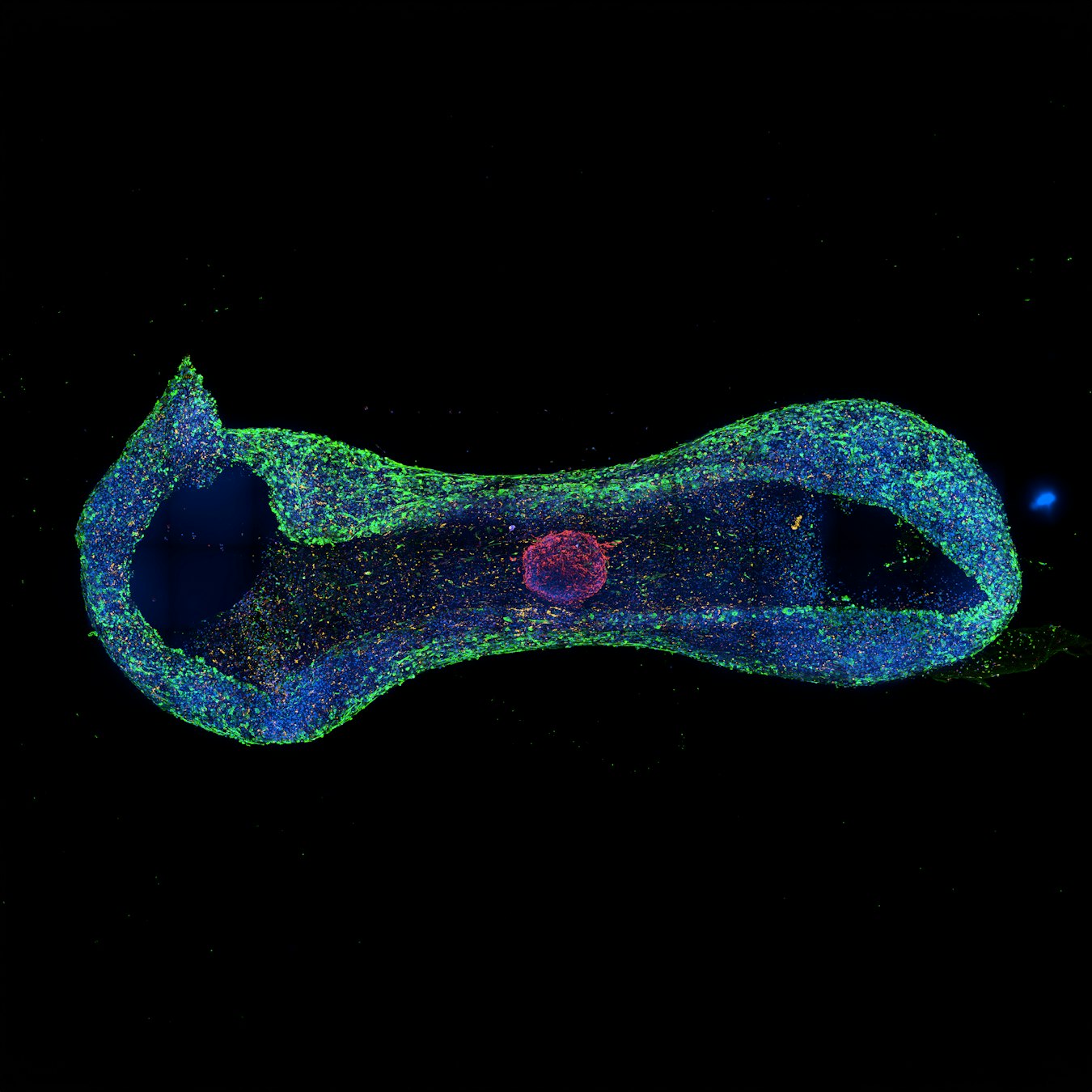
A tiny strip of lab-grown heart tissue with a small sphere of nerve cells near its center. The heart cells can beat, while the nerve cells can help control their rhythm. - Blue: cell nuclei, which contain the cells’ genetic information
Green: myocytes, the beating heart muscle cells
Orange: endothelial cells, which normally line blood vessels
Pink: sympathetic neurons, nerve cells that can make the heart beat faster
- Where is it found?
This muscle is found in the walls of the heart, where it contracts to pump blood throughout the body. This tissue was grown in the lab to mimic human heart muscle.
- How big is it?
This tissue is about 6 millimeters ≈ the length of a grain of rice. The sphere of nerve cells is about 500 micrometers ≈ the width of 6 human hairs
- What can we learn from this image?
By growing heart cells and nerve cells together, scientists can recreate a small but important part of the human heart in the lab and study it up close.
- What are its superpowers?
This tiny piece of tissue can beat on its own, contracting and relaxing like a miniature heart muscle. When the attached neurons are activated, they can send signals to the heart cells and make them beat faster.
- How was this image taken?
This image was taken with a high-content imaging microscope at 20× magnification
- Image: Eurac Research / Federica Cavion – Cellular Biologist
- What are scientists trying to understand with this image?
Scientists want to understand how the nervous system controls the heartbeat and how diseases, drugs, and other substances can affect this connection. To do this they use a 3D model made from human cells.
The story behind the image
This miniature heart-and-nerve system was grown from human stem cells. By combining different types of cells in one model, researchers can recreate part of the conversation that the heart has with the nervous system, and they can also watch what happens when that conversation changes.
Credits: Eurac Research / Federica Cavion