09
A galaxy of connections
- What do you see?
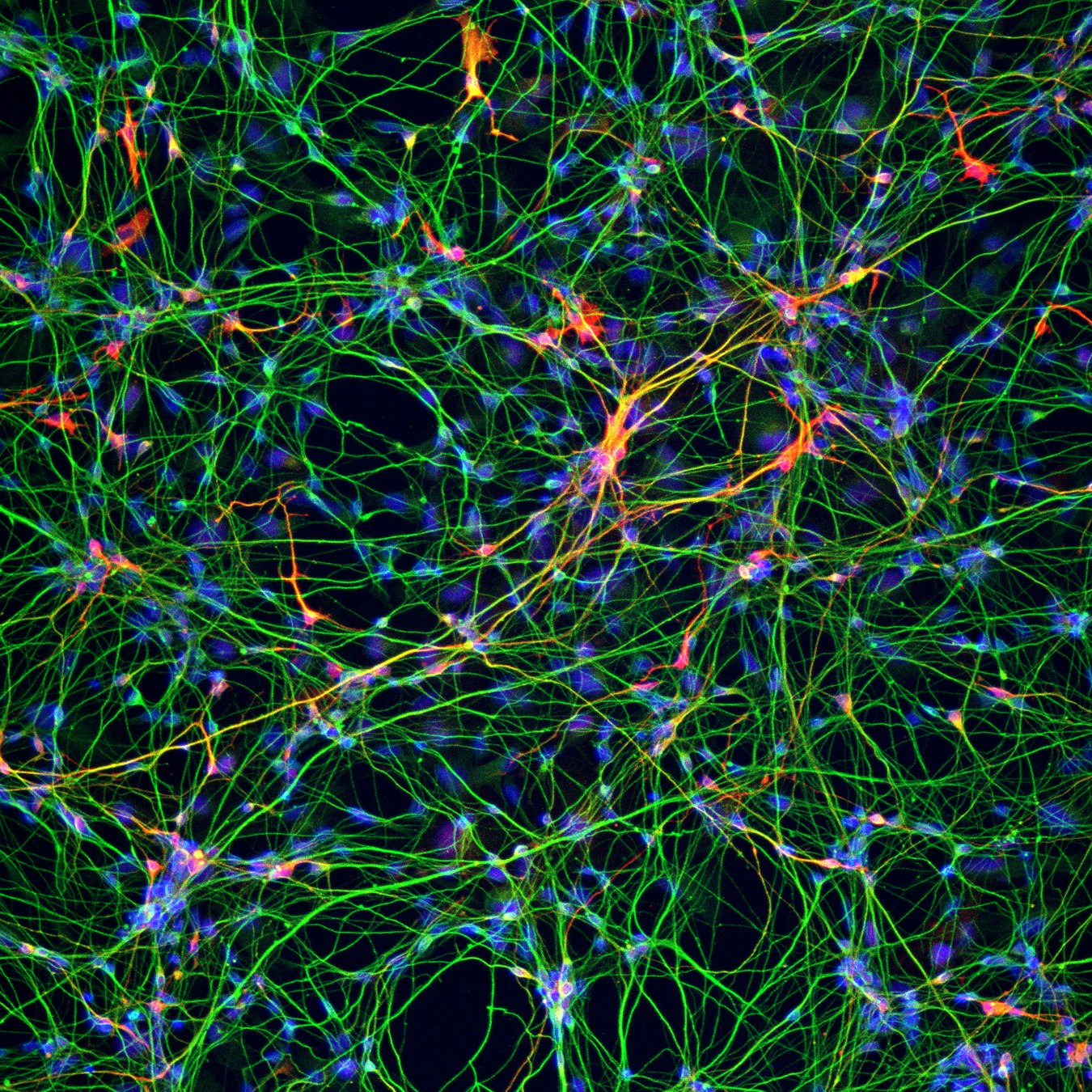
An interconnected network of dopamine-producing neurons grown from human stem cells in a laboratory. Their long branches reach out in all directions, forming communication pathways that allow nerve cells to connect. - Blue: Cell nuclei
Green: Neurons
Red: Dopamine-producing neurons
- Where are they found?
In the human brain, dopamine-producing neurons are found deep within a region called the substantia nigra. From there, they help control movement, learning, motivation, and the brain’s reward system.
- How big are they?
The entire image is about 900 micrometers (µm) wide.
≈ 10 human hairs placed side by side
Each neuron’s cell body is only 10–30 µm across, while its long extensions are around 100 times thinner than a human hair, making them invisible without a microscope.
- What can we learn from this image?
The brain is built through connections. As dopamine-producing neurons grow, they extend long branches to find neighboring cells and establish communication networks. These connections are essential for healthy brain function and begin forming long before the brain is fully developed.
- What are their superpowers?
These neurons produce dopamine, a chemical messenger that helps us move, learn from experience, stay motivated, and experience reward and pleasure.
- How was this image taken?
This image was captured using a confocal microscope, which combines laser light and fluorescent labels to reveal tiny cellular structures in remarkable detail. The technique allows scientists to see individual neurons and their delicate connections that would otherwise remain invisible.
- Image: Eurac Research / Giulia Pedrotti – Neuroscientist
- What are scientists trying to understand with this image?
Scientists are studying how dopamine-producing neurons develop, communicate, and why they are especially vulnerable in Parkinson’s disease. Understanding how these cells function, and why they gradually die, may help researchers develop new treatments for neurodegenerative disorders.
The story behind the image
At first glance, this image could be mistaken for a distant galaxy, with bright stars connected by glowing filaments. But this “constellation” exists inside living cells. These are dopamine-producing neurons, reaching out as they grow and develop. Every new connection brings them one step closer to forming the communication networks needed for movement, learning, and motivation. This tiny world reminds us that the brain can be just as intricate as the universe that surrounds us.
Credits: Eurac Research / Giulia Pedrotti