08
The neuron that moves you
- What do you see?
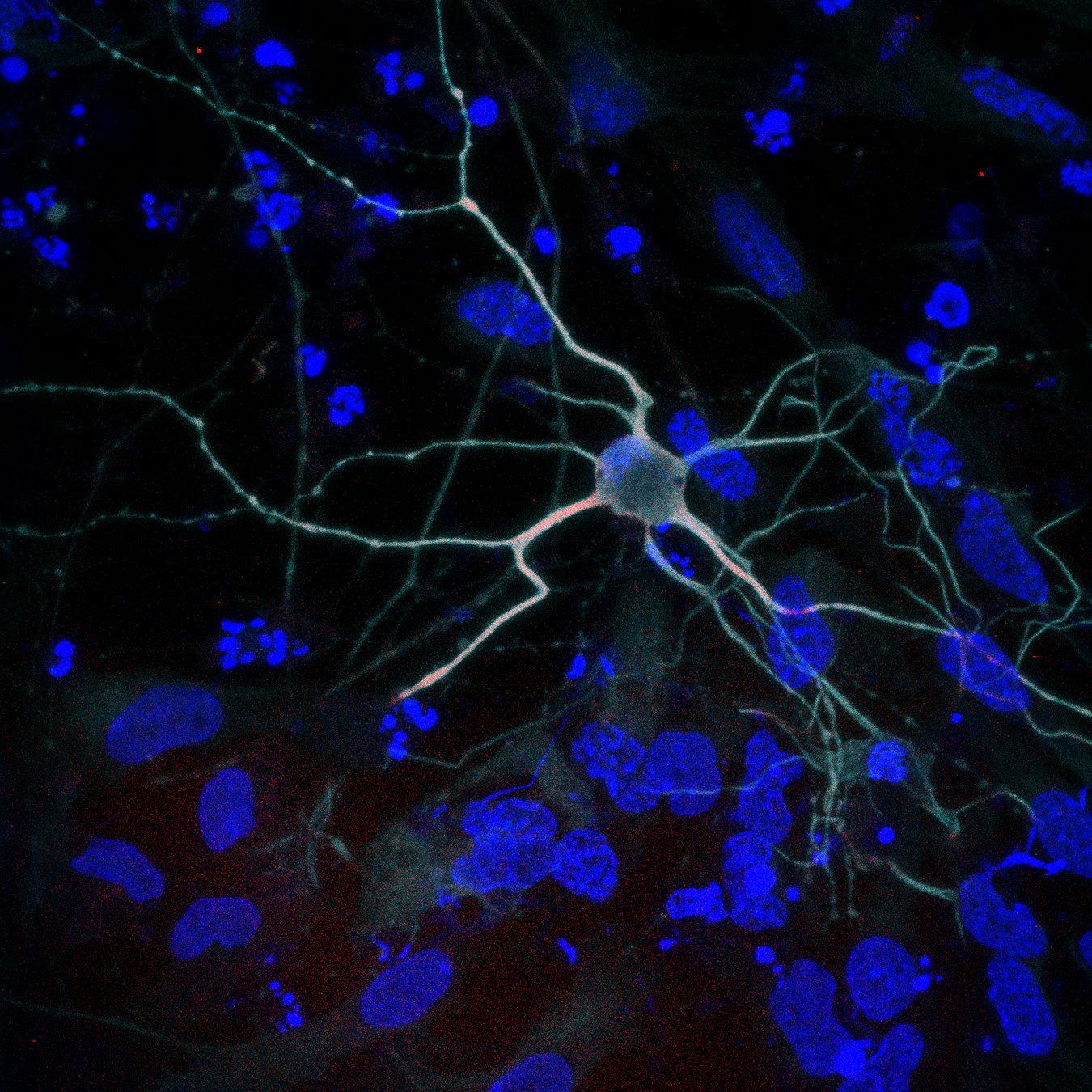
A dopamine-producing neuron grown in the laboratory from human induced pluripotent stem cells. The cell has developed its characteristic shape, with a central cell body and long extensions that will one day carry signals to other neurons. - Blue: Cell nuclei
Cyan: A structural protein found in all neurons
Red: An enzyme that produces dopamine, identifying this neuron as a dopamine-producing cell
- Where is it found?
This image shows a neuron grown in the laboratory from human stem cells. In the human brain, these neurons are found deep within the substantia nigra, a small region in the midbrain. From there, they help coordinate smooth, voluntary movements.
- How big is it?
The cell body is about 10–20 micrometers across.
Its long fibers can extend for several centimeters. Some individual axons can reach meters in length.
- What can we learn from this image?
Not all neurons are the same: different types have specialized jobs, and scientists can identify them by the proteins they produce. This image reveals a dopamine-producing neuron, one of the most important cell types for controlling movement.
- What are its superpowers?
This neuron produces and releases dopamine, a chemical messenger that allows different parts of the brain to communicate. Without these neurons, voluntary movements become slow, stiff, and difficult to control.
- How was this image taken?
Scientists used a technique that labels specific proteins with fluorescent markers called immunostaining and then captured the image using a confocal microscope to reveal the neuron’s fine structure.
- Image: Eurac Research / Mattia Volta – Neuroscientist, Francesca Pischedda, Asiye Malkoç
- What are scientists trying to understand with this image?
Scientists are investigating how dopamine-producing neurons develop, function, and gradually become damaged in Parkinson’s disease. By identifying the earliest changes in their structure and electrical activity, researchers hope to find ways to protect these cells before they are lost.
The story behind the image
This neuron may look peaceful, but it performs one of the brain’s most demanding jobs. Every movement you make, from taking a step to smiling or writing your name, depends on dopamine-producing neurons working in perfect harmony. By studying these cells long before disease appears, scientists hope to understand why they are so vulnerable and how they can be protected.
Credits: Eurac Research / Mattia Volta