07
The cell’s powerhouse
- What do you see?
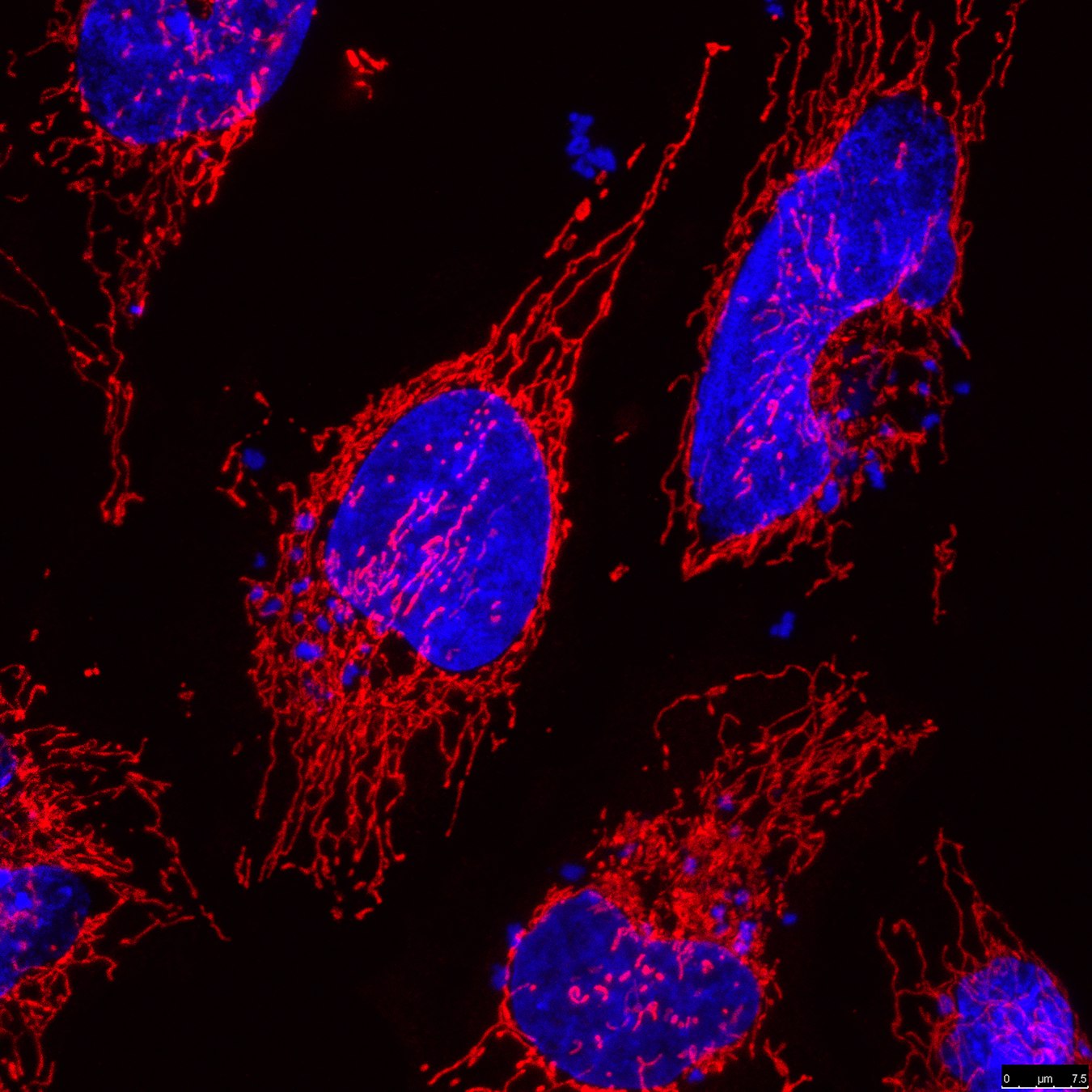
A network of mitochondria forming long, interconnected tubes inside cultured human cells. Rather than existing as separate bean-shaped structures, these tiny energy-producing organelles create a dynamic network that stretches throughout each cell. - Blue: Cell nuclei (parts of three cells are visible)
Red: Mitochondria
- Where are they found?
Mitochondria are found in the cells of almost all living organisms. In the brain, they are especially important because neurons require large amounts of energy to communicate and function properly. The mitochondria shown here form part of cells grown in the laboratory for research.
- How big are they?
These tiny tubes are about 0.5–1 micrometer thick and can extend for several micrometers.
≈ 1/100 the thickness of a human hair
- What can we learn from this image?
Healthy mitochondria often form an interconnected network that constantly changes shape by joining together and splitting apart. By observing how connected or fragmented these networks are, scientists can tell whether a cell is healthy, under stress, or beginning to malfunction.
- What are their superpowers?
Mitochondria are best known as the cell’s power stations. They use oxygen to convert nutrients into energy, but they also help cells respond to stress and stay healthy.
- How was this image taken?
This image was captured using a laser scanning confocal microscope. Like a hospital CT scanner, this microscope creates optical sections through a sample. Instead of imaging the human body, it reveals structures inside single cells. To make these structures visible, scientists label them with fluorescent molecules.
- Image: Eurac Research / Alexandros Lavdas – Neuroscientist, Irene Pichler
- What are scientists trying to understand with this image?
Scientists are investigating how the mitochondrial network changes under different conditions. Instead of acting as isolated organelles, mitochondria constantly fuse and divide. The balance between these processes reflects the cell’s health, making the mitochondrial network an important indicator of stress, health and disease.
The story behind the image
What looks like a delicate red web is actually a living network inside cultured cells. Far from being static structures, mitochondria are constantly reshaping themselves by uniting, splitting, and responding to the cell’s needs. By watching how this network changes, scientists can detect early signs of stress and gain valuable insights into the health of the cell long before it stops functioning.
Credits: Eurac Research / Alexandros Lavdas