12
Growing connections
- What do you see?
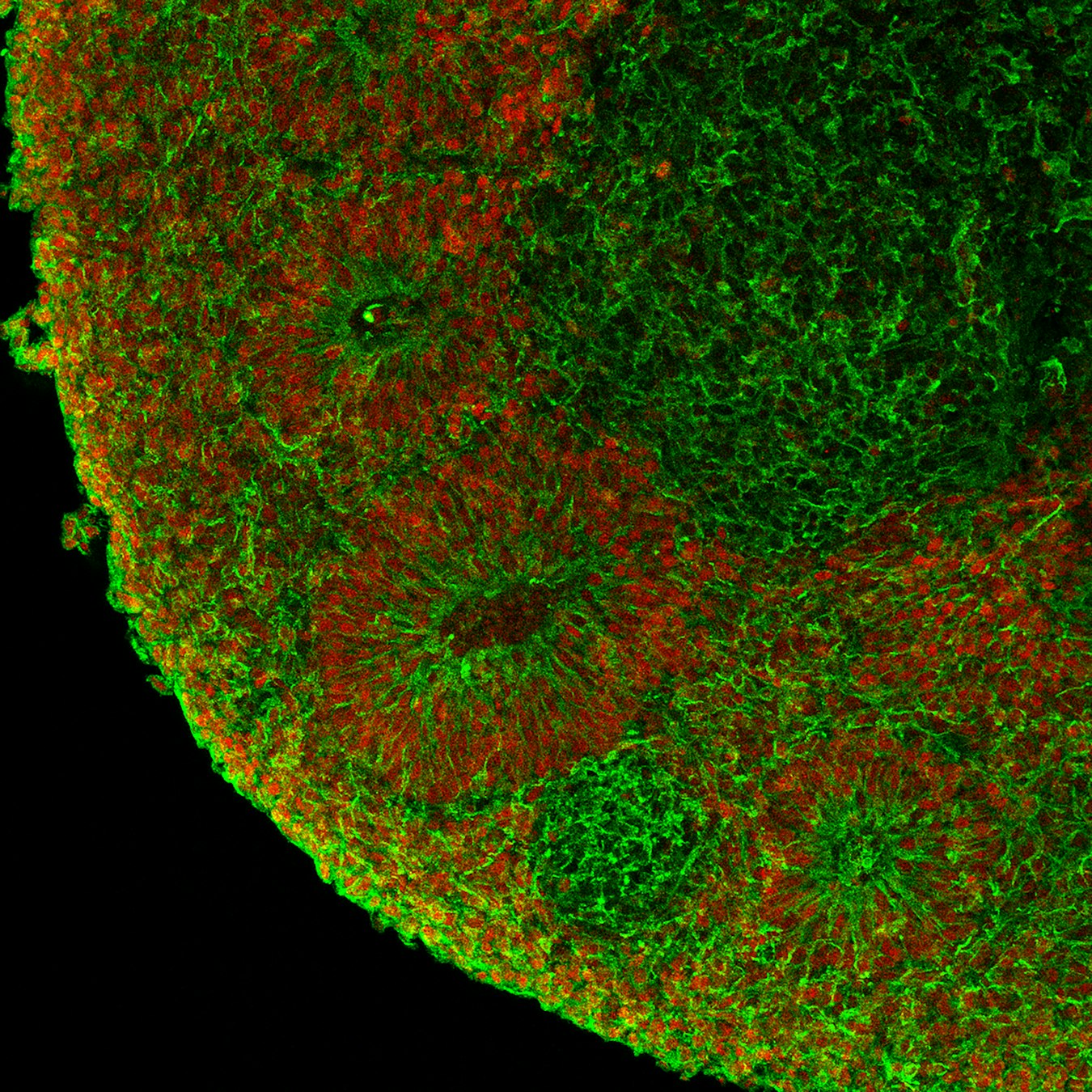
A 30-day-old human midbrain organoid grown in the laboratory from induced pluripotent stem cells. This three-dimensional model recreates key features of the developing human midbrain, including young neurons and cells that can give rise to dopamine-producing neurons.
Green: Developing neurons
Red: Cells characteristic of the developing ventral midbrain, the region where dopamine-producing neurons emerge
- Where is it found?
Midbrain organoids do not occur naturally in the body. Scientists grow them from human stem cells in the laboratory to recreate aspects of the human midbrain and study its early development.
- How big is it?
This organoid is approximately 1–2 millimeters in diameter.
≈ about the size of a pinhead
- What can we learn from this image?
In just 30 days, stem cells can organize themselves into complex three-dimensional structures containing different types of developing brain cells. By identifying where these cells appear within the organoid, scientists can follow some of the early steps involved in building the human midbrain.
- What are its superpowers?
These miniature tissues can self-organize, with cells developing different identities and arranging themselves into complex three-dimensional structures. This allows scientists to observe aspects of human brain development in the laboratory and investigate what changes when neurological diseases develop.
- How was this image taken?
This image was captured using a confocal microscope, which uses laser light and fluorescent markers to reveal the organization of cells and tissues in remarkable detail.
- Image: Eurac Research / Ingrid Battistella – Neuroscientist
- What are scientists trying to understand with this image?
Scientists are studying how dopamine-producing neurons develop and communicate, and why these cells become especially vulnerable in disorders such as Parkinson’s disease. Organoids may also help researchers explore new treatments and, in the future, develop therapies tailored more closely to individual patients.
The story behind the image
Thirty days earlier, these cells began their journey as human stem cells. Now they are organizing themselves into a tiny three-dimensional model of the developing midbrain. Different cells are taking on specialized identities, including those that will give rise to dopamine-producing neurons. By following this transformation in the laboratory, scientists can watch some of the earliest steps of human brain development unfold before their eyes.
Credits: Eurac Research / Ingrid Battistella