11
Reaching out
- What do you see?
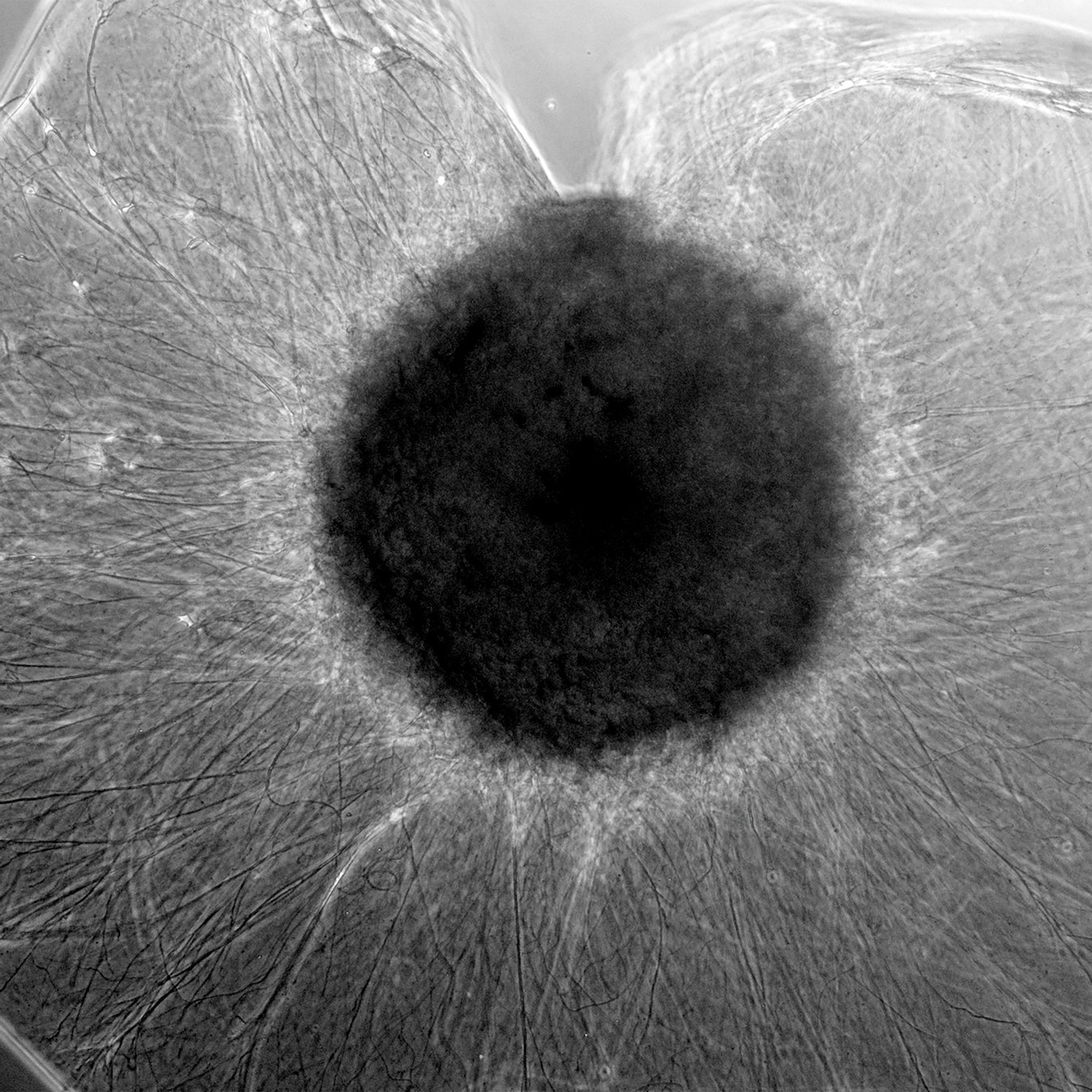
A 17-day-old human midbrain organoid growing in the laboratory. From its dense center, young neuronal fibers called axons extend outward into the surrounding material, reaching into their environment as the organoid develops. - Darker area: The cell-rich core of the organoid
Lighter areas: Growing nerve fibers extending into the surrounding material
- Where is it found?
This miniature model of the human midbrain does not occur naturally in the body. Scientists grew it in the laboratory from human stem cells to recreate some of the features of the developing brain.
- How big is it?
The organoid is approximately 2 millimeters in diameter.
≈ the size of a sesame seed
- What can we learn from this image?
Even at just 17 days old, this tiny brain model is already highly active. Its developing neurons send out long fibers into their surroundings, one of the first steps toward forming the connections that allow nerve cells to communicate.
- What are its superpowers?
Organoids give scientists a window into human brain development that would otherwise be extremely difficult to observe. They recreate important features of human brain tissue in the laboratory, allowing researchers to watch cells develop and investigate what happens when these processes go wrong.
- How was this image taken?
This image was captured using brightfield microscopy, a technique that uses transmitted light to reveal cells and structures without the fluorescent labels seen in the other images in this exhibition.
- Image: Eurac Research / Ingrid Battistella – Neuroscientist
- What are scientists trying to understand with this image?
Scientists use these miniature brain models to investigate how the human midbrain develops and what happens to its cells in neurodegenerative diseases such as Parkinson’s. By recreating aspects of the disease in the laboratory, researchers can study its mechanisms and explore potential new treatments.
The story behind the image
It may be only the size of a sesame seed, but this tiny structure is beginning to show some of the remarkable behavior of the developing human brain. From its densely packed center, young neurons send delicate fibers outward, reaching into their surroundings and beginning to build connections. By watching this process unfold in the laboratory, scientists gain a rare glimpse into how the human brain develops and what may happen when that development or later function is disrupted.
Credits: Eurac Research / Ingrid Battistella